The VRC has posted our images from the Department of Art and Art History's fall 2011 commencement ceremony on our Flickr page. Congratulations to all, our very best wishes for the future, and please stay in touch with the department. Our Alumni Newsletter and Facebook are easy ways to let us (and your classmates) know where life is taking you.
Do you have images from this or other departmental events? Please help us document our departmental history by joining the department's Flickr group and sharing them there.
Visual Resources Center, Department of Art and Art History
University of Colorado Boulder
Friday, December 30, 2011
Thursday, December 22, 2011
Garrison Roots, We Will Always Miss You
![]() | ||
| Garrison,Visual Arts Complex Dedication Ceremony. Sept. 2010 |
Garrison guided the department as we moved from an amorphous program plan to our newly constructed Visual Arts Complex. While our fabulous new state-of-the-art home is a physical monument to his achievements, Garrison's less visible contributions to the soul of our department were even more important. He was a unifying force who chose to see the best in every human being. He gave everyone a forum to speak and the agency to act, which made us all feel like invested members of a community, even part of a family.
Personally, I appreciate so much the kind support and great humor he always shared with me. I tried not to abuse the open door policy in his office, but his approachability made it so easy to just drop by to say hello or bring up any issues on my mind. And while it's pretty unusual for anyone to look forward to staff meetings, we always did because they were productive yet full of laughter and good cheer.
Garrison was a humble person who always insisted on sharing credit whenever he was praised. I wish he were here now to protest, saying that our new building was the result of the work of many people, and that our department is where we are today because the faculty and staff have made it that way. True, true, Garrison, but these things do not happen without great leadership. We thank you, and we will always remember you with much love, respect, and gratitude.
Tuesday, December 13, 2011
Historic Advertisements from Duke Library: Ad*Access and Emergence of Advertising in America: 1850 - 1920
Ad*Access
The main categories are Beauty and Hygiene, Radio, Television, Transportation, and World War II Propaganda. You can also browse and search by Company, Product, Date, Publication, Subject, Medium, Headline, and Audience.
Note the section on Copyright and Citation. Most of these advertisements were published after 1923, which means they are still protected by copyright. Under the fair use exemption to copyright, Duke makes them available to you for use in research, teaching, and private study, on the condition that you provide proper attribution of the source in all copies. You must seek permission for other uses. Detailed information on how to properly cite and seek permission to use these images is provided on this page.
Emergence of Advertising in America: 1850 - 1920
Browse the collection by Company, Product, Date, Format, Publication, Subject, Medium, and Headline.
As with Ad*Access there is a Copyright and Citation page, with an explanation that these images are available for your use in research, teaching, and private study. While it's arguable that Duke cannot claim copyright to these pre-1923 images, and therefore cannot require permission for other uses (such as publication), it is certainly good form to contact them before doing so.
Tuesday, December 6, 2011
Little Guides from JISC Digital Media
JISC Digital Media has created a series of Little Guides in response to frequently asked questions. Perhaps of most interest to our readers is The Little Guide to Finding Digital Media Resources (PDF). This guide includes links to JISC's online tutorials on searching the Internet for images, audio resources, and video and moving images, as well as links to general sites with a focus on free-to-use and low-cost media resources.
Other JISC Little Guides address Copyright, Cloud Computing, Podcasting, and Screencasting.
In general, JISC Digital Media provides a wealth of helpful information for those in higher education anywhere, but do keep in mind that JISC is a service aimed at a UK audience. Some of the resources cited here are slanted in this direction.
Image: Ryan Thompson (Warmest Regards), consulting the guide books, 2010. Available from Flickr under a Creative Commons Attribution-NonCommercial-ShareAlike 2.0 Generic License.
Other JISC Little Guides address Copyright, Cloud Computing, Podcasting, and Screencasting.
In general, JISC Digital Media provides a wealth of helpful information for those in higher education anywhere, but do keep in mind that JISC is a service aimed at a UK audience. Some of the resources cited here are slanted in this direction.
Image: Ryan Thompson (Warmest Regards), consulting the guide books, 2010. Available from Flickr under a Creative Commons Attribution-NonCommercial-ShareAlike 2.0 Generic License.
Wednesday, November 30, 2011
Copyright, Fair Use, and Online Images
A recent conversation with someone in the Art and Art History department reminded me that confusion over the online use of copyrighted images persists, even among some faculty members. This really comes as no surprise. Copyright is complex, the parameters of fair use are murky, and the fair use of digital images require us to consider elements that didn't exist when the Copyright Act of 1976 was passed. It's a mystifying topic for most of us. Over at the Social Media Examiner, Sara Hawkins has written a very helpful piece, Copyright Fair Use and How it Works for Online Images. As an attorney, Hawkins is well versed on this subject, and here she provides an excellent overview of the issues that we should consider before using others' images online.
While brief, the article does a great job of introducing this complicated subject. After discussing key points about copyright and fair use, Hawkins outlines "5 Things to Think About Before Using Copyrighted Images":
Image: Jason Pettus (jasonpettus), mytatt.jpg, 2007, available from Flickr under a Creative Commons Attribution-NonCommercial-NoDerivs 2.0 Generic license.
While brief, the article does a great job of introducing this complicated subject. After discussing key points about copyright and fair use, Hawkins outlines "5 Things to Think About Before Using Copyrighted Images":
- Do you understand the term fair use?
- Why are you using the image?
- Have you transformed the image?
- How much of the image are you using?
- Are you willing to risk your site being taken down, getting a cease and desist/bill/DMCA or being sued?
Image: Jason Pettus (jasonpettus), mytatt.jpg, 2007, available from Flickr under a Creative Commons Attribution-NonCommercial-NoDerivs 2.0 Generic license.
Tuesday, October 4, 2011
Historical Medical Images Online
A graduate student recently asked me about where she might find historical medical images online. I am posting these resources here because this is a recurring topic of interest among faculty and students in both art history and studio arts. Do you have other suggestions? Please share them with us.
Wellcome Images
Over 40,000 current and historical medical images; "Wellcome Images is one of the world's richest and most unique collections, with themes ranging from medical and social history to contemporary healthcare and biomedical science." Explore Wellcome images here.
Images from the History of Medicine (IHM)
"Provides access to nearly 70,000 images in the collections of the History of Medicine Division (HMD) of the U.S National Library of Medicine (NLM)." Search for IHM images here.
Pictures of Science: 700 Years of Scientific and Medical Illustration (New York Public Library)
"Hundreds of images from the thirteenth through the early twentieth century, in the fields of astronomy, chemistry, geology, mathematics, medicine, and physics, as represented by manuscript illuminations, engravings, lithographs, and photographs." Discover Pictures of Science images from the NYPL Digital Gallery here.
Historical Medical Poster Collection (Yale's Cushing/Whitney Medical Library)
"The collection ranges from large size posters meant to be pasted on the sides of buildings and viewed from afar to small glossy placards designed for store windows...The collection focuses primarily on public health communications, but also has examples of medical product advertising, recruiting, and aid and relief solicitations." Find images from the Historical Medical Poster Collection here.
Image: Clemente Susini, Wax anatomical figure of reclining woman, 1771-1800, Florence.Science Museum, London, Wellcome Image. Available under a Creative Commons Attribution-NonCommercial-NoDerivs 2.0 Generic license.
Wellcome Images
Over 40,000 current and historical medical images; "Wellcome Images is one of the world's richest and most unique collections, with themes ranging from medical and social history to contemporary healthcare and biomedical science." Explore Wellcome images here.
Images from the History of Medicine (IHM)
"Provides access to nearly 70,000 images in the collections of the History of Medicine Division (HMD) of the U.S National Library of Medicine (NLM)." Search for IHM images here.
Pictures of Science: 700 Years of Scientific and Medical Illustration (New York Public Library)
"Hundreds of images from the thirteenth through the early twentieth century, in the fields of astronomy, chemistry, geology, mathematics, medicine, and physics, as represented by manuscript illuminations, engravings, lithographs, and photographs." Discover Pictures of Science images from the NYPL Digital Gallery here.
Historical Medical Poster Collection (Yale's Cushing/Whitney Medical Library)
"The collection ranges from large size posters meant to be pasted on the sides of buildings and viewed from afar to small glossy placards designed for store windows...The collection focuses primarily on public health communications, but also has examples of medical product advertising, recruiting, and aid and relief solicitations." Find images from the Historical Medical Poster Collection here.
Image: Clemente Susini, Wax anatomical figure of reclining woman, 1771-1800, Florence.Science Museum, London, Wellcome Image. Available under a Creative Commons Attribution-NonCommercial-NoDerivs 2.0 Generic license.
Thursday, September 22, 2011
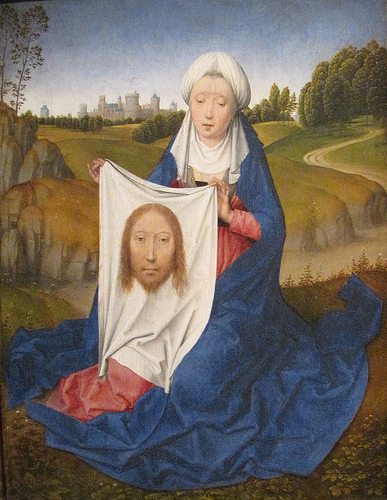
Christian Iconography from Augusta State University
Who's that woman holding the cloth depicting an image of Christ? If you have ever found yourself wondering who is featured in a particular scene from a medieval or early modern work of art , Christian Iconography could be a valuable resource. From Augusta State University, this work-in-progress is intended "to support the study of Christian iconography at the beginner's level." Its taglines are "Learn how to identify the saints in medieval and renaissance art. Read the stories that the paintings refer to. Find out the 'why' behind traditional elements in paintings of scriptural events."
You can enter a keyword to search for a particular iconographical element, or you can explore links on specific saints, topics, or selected scriptural events which are divided alphabetically. Each of these is illustrated by one or more images. There are also links to other sites useful in the study of Christian iconography, as well as a bibliography of recommended readings.
Image: euthman (Ed Uthman), Hans Memling: St. Veronica, c. 1470/1475, 2009. Available from Flickr under a Creative Commons Attribution-NonCommercial-NoDerivs 2.0 Generic License.
You can enter a keyword to search for a particular iconographical element, or you can explore links on specific saints, topics, or selected scriptural events which are divided alphabetically. Each of these is illustrated by one or more images. There are also links to other sites useful in the study of Christian iconography, as well as a bibliography of recommended readings.
Image: euthman (Ed Uthman), Hans Memling: St. Veronica, c. 1470/1475, 2009. Available from Flickr under a Creative Commons Attribution-NonCommercial-NoDerivs 2.0 Generic License.
Monday, September 12, 2011
Delicious: A Resurrection Ahead for Social Bookmarks?
If you've seen the VRC's bookmarks over at Delicious you know that we have assembled over a thousand bookmarks from Web sites pertaining to art, architecture, archaeology, museums, images, and related information resources. We have tagged these links with labels to help you navigate through them and find sites of interest. And more importantly, we are not alone -- over 5 million other individuals and organizations have bookmarked and tagged almost 200 million sites. Pick just about any topic and Delicious can lead you to new online resources, and to other users with similar interests who have publicly shared their bookmarks.
So far so good. But a troubling development came to light last year. A leak at Yahoo!, which had acquired Delicious in 2005 and had done little since to develop its potential, indicated that the service was to be "sunsetted," which many interpreted as "to be shut down." Yahoo! publicly declared that this meant that they would be selling Delicious, rather than ending it. But many users by now had decided that investing time in social bookmarking at Delicious was a risky endeavor. Many accounts, including the VRC's, were left in a holding pattern until the dust settled.
Ashes to ashes and dust to dust aside, Delicious was acquired in April by AVOS Systems, a company founded by the creators of YouTube. As reported in a New York Times piece today, these entrepreneurs are now using their expertise to breath new life into Delicious. Among their goals is greater ease of use and broader adoption. These will be fueled by the collective desire for better control of the torrential flow of information that we all experience. As Chad Hurley states, “We want to simplify things visually, mainstream the product and make it easier for people to understand what they’re doing." We look forward to watching the developments at Delicious, and resuming our bookmarking activities soon. Stay tuned!
Image: Daniel Andrlik (mointrigue), Delicious Is Dead, 2010, available from Flickr under a Creative Commons Attribution-NonCommercial-ShareAlike 2.0 Generic license.
So far so good. But a troubling development came to light last year. A leak at Yahoo!, which had acquired Delicious in 2005 and had done little since to develop its potential, indicated that the service was to be "sunsetted," which many interpreted as "to be shut down." Yahoo! publicly declared that this meant that they would be selling Delicious, rather than ending it. But many users by now had decided that investing time in social bookmarking at Delicious was a risky endeavor. Many accounts, including the VRC's, were left in a holding pattern until the dust settled.
Ashes to ashes and dust to dust aside, Delicious was acquired in April by AVOS Systems, a company founded by the creators of YouTube. As reported in a New York Times piece today, these entrepreneurs are now using their expertise to breath new life into Delicious. Among their goals is greater ease of use and broader adoption. These will be fueled by the collective desire for better control of the torrential flow of information that we all experience. As Chad Hurley states, “We want to simplify things visually, mainstream the product and make it easier for people to understand what they’re doing." We look forward to watching the developments at Delicious, and resuming our bookmarking activities soon. Stay tuned!
Image: Daniel Andrlik (mointrigue), Delicious Is Dead, 2010, available from Flickr under a Creative Commons Attribution-NonCommercial-ShareAlike 2.0 Generic license.
Thursday, September 8, 2011
VRC Bombay TV 2 Video
To illustrate some of the ways we help our faculty and students, and also to show that we do our jobs with humor while striving for excellent services and products, the VRC has created a very short and hopefully entertaining video about our scanning services. We used Bombay TV 2, a site offering a selection of clips from vintage Bollywood movies, which you can choose, arrange into a sequence, and provide subtitles to create your own movie. See the video here:
http://www.grapheine.com/bombaytv/v2/play.php?id=152979
But seriously, if you are faculty member or student in the Department of Art and Art History, please ask us how we can make your life easier. Scanning? Training? Equipment? If you are in need of a service or equipment item that we don't currently offer but which fits within our mission -- to provide and facilitate access to images, imaging, and related information resources for teaching and research -- we would like to hear about it.
Disclaimer: No faculty members, students, or Bollywood stars were harmed in the making of this video. All characters are fictional; any resemblance to real persons, living or dead, is purely coincidence and unintended (except the guy who gets thrown through the plate glass window -- that really happened!). The VRC welcomes discourse about the representation of American academic problems as expressed through the representation of an Other culture, namely that of upper-class 1970s Mumbai, which itself is represented here through the lens of 1970s Hindi cinema. Similarly, we invite the discussion of any post-colonial ethical issues that may be called into question by framing this presentation with humor, or questions arising from the androcentric positioning of an aggressive male protagonist who is assisted entirely by female characters -- especially if these discussions occur over lattes.
http://www.grapheine.com/bombaytv/v2/play.php?id=152979
But seriously, if you are faculty member or student in the Department of Art and Art History, please ask us how we can make your life easier. Scanning? Training? Equipment? If you are in need of a service or equipment item that we don't currently offer but which fits within our mission -- to provide and facilitate access to images, imaging, and related information resources for teaching and research -- we would like to hear about it.
Disclaimer: No faculty members, students, or Bollywood stars were harmed in the making of this video. All characters are fictional; any resemblance to real persons, living or dead, is purely coincidence and unintended (except the guy who gets thrown through the plate glass window -- that really happened!). The VRC welcomes discourse about the representation of American academic problems as expressed through the representation of an Other culture, namely that of upper-class 1970s Mumbai, which itself is represented here through the lens of 1970s Hindi cinema. Similarly, we invite the discussion of any post-colonial ethical issues that may be called into question by framing this presentation with humor, or questions arising from the androcentric positioning of an aggressive male protagonist who is assisted entirely by female characters -- especially if these discussions occur over lattes.
Labels:
fun,
video resources,
VRC,
Web 2.0
Wednesday, August 31, 2011
Are Your Images Safe?
The VRC has returned from our all-too-short summer break -- welcome back! I'd like to kick off the new school year with a cautionary tale. This July my brother's and sister-in-law's home was flooded, destroying the family computer. They did have an automatic backup system in place, saving regularly to an external hard drive. However, the hard drive was also destroyed in the flood. Fortunately, they periodically saved data to DVDs and stored them elsewhere, but the family lost all of the information on the computer that had been created since the last backup.
Many of us invest a significant amount of time, energy, and money in creating, collecting, and storing our images: they support our professional activities and function as an archive for our most treasured memories. Have you thought carefully about the ways that yours are vulnerable?
I have written about backup strategies before. Backups are a very important aspect of ensuring the ongoing safety and accessibility of your images. But there are other factors to consider, such as methods of organizing, file naming, migrating, and monitoring both your collection and developments in technology, products, and standards. SaveMyMemories.org is a nice site that provides a layperson's introduction to developing a strategy for curating your collection of personal images. Its main categories are:
Image: Rachel Zack, Mom, 2007. From Flickr, available under a Creative Commons Attribution-NonCommercial 2.0 Generic license.
Many of us invest a significant amount of time, energy, and money in creating, collecting, and storing our images: they support our professional activities and function as an archive for our most treasured memories. Have you thought carefully about the ways that yours are vulnerable?
I have written about backup strategies before. Backups are a very important aspect of ensuring the ongoing safety and accessibility of your images. But there are other factors to consider, such as methods of organizing, file naming, migrating, and monitoring both your collection and developments in technology, products, and standards. SaveMyMemories.org is a nice site that provides a layperson's introduction to developing a strategy for curating your collection of personal images. Its main categories are:
- Learn (hardware; software; other factors)
- Prepare (plan; create categories; label photos; manage photos)
- Protect (transfer to storage; make backup plan; how to backup)
- Recover (camera card failure; hard drive crash; virus attack)
- Resources (provides lots of links, organized into categories, to important sources for more information)
Image: Rachel Zack, Mom, 2007. From Flickr, available under a Creative Commons Attribution-NonCommercial 2.0 Generic license.
Subscribe to:
Posts (Atom)